

As a nurse for more than 20 years—most of them at the bedside in ICUs—and 15 years in clinical informatics at systems like Bon Secours and Cleveland Clinic, I’ve seen a consistent truth: communication makes or breaks patient safety. Today, at TigerConnect, my focus is on helping hospitals implement, optimize, and prove ROI on modern communication workflows so clinical teams can move faster with fewer errors, because time is tissue in healthcare.
This year, IHI’s Patient Safety Awareness Week (PSAW), which runs March 8–14, has the theme “Team Up for Patient Safety”—a timely reminder that safer care happens when patients, families, and care teams work together with clarity and purpose. It’s also a call to action: close the communication gaps that allow harm to sneak into our workflows.
At TigerConnect, we’re committed to helping hospitals deliver safe, high-quality care for all by eliminating delays, reducing cognitive burden, and modernizing how critical information flows through the enterprise.
Where Communication Breakdowns Drive the Most Risk
When we look across our customer community, a familiar set of patient safety challenges emerges—almost all of them amplified by information latency or signal overload.
The following sections (1–7) highlight the many points where communication can break down and threaten patient safety. Each represents a critical area where delays or gaps can cause harm. By examining these real-world challenges, we’re making the case for intelligent care orchestration—showing that true safety and efficiency require coordinated solutions that address every breakdown point. By orchestrating reliable communication across all seven areas, we enable healthcare teams to consistently “win”.
1) Delay of Care
The biggest, most visible driver of harm. When critical updates don’t reach the right clinician at the right moment, time-sensitive interventions slip. Remember: time is tissue—every minute lost to communication delays can damage organs, prolong stays, and increase risk.
How to fix it:
- Roles-based routing so messages go to who’s on right now—not just a name in a directory.
- Automated team activation so everyone needed for a time-critical response is notified at once.
- Closed-loop communication so it’s clear who acknowledged and what happened next.
- Pre-arrival notifications so the Emergency Department receives timely and accurate patient information before arrival via TigerConnect Pre-Hospital.
2) Medication Errors
Verbal handoffs, incomplete orders, unread inbox messages—these are fertile ground for wrong dose/time/drug mistakes.
How to fix it:
- Structured order-to-action notifications (e.g., pharmacist review complete → nurse alerted).
- Read receipts and escalation if time-sensitive orders go unacknowledged.
- Standardized channels for clarifying questions between prescribers, pharmacy, and nursing.
3) Hospital-Acquired Infections (HAIs)
Gaps in timely isolation, delayed lab result follow-up, and unclear responsibility increase the risk of infection.
How to fix it:
- Automatic alerts when positive cultures or isolation criteria hit the EHR.
- Instant routing to infection prevention and the responsible nurse/physician.
- Checklists embedded in team channels to standardize response.
- Real-time notification of isolation status or other precautions via the Smart Room digital door sign outside the patient room, ensuring everyone sees the update without delay.
4) Patient Falls
Risk assessments don’t help if the alerts don’t reach the right care team member in time.
How to fix it:
- Direct routing of bed-exit alarms and nurse call events to the assigned nurse or PCT.
- Real-time collaboration for rapid assist and post-fall huddle.
5) Transfer of Care Errors
Handoffs between units, shifts, or facilities are classic moments for information loss.
How to fix it:
- Structured, templated handoffs with required fields and attachments.
- TigerConnect CareConduit & Transfer workflows that package the critical few (not the trivial many) and make them actionable.
6) Patient Identification Errors
Mislabeling a specimen or failing to verify identity is often a process + communication breakdown.
How to fix it:
- Barcode-confirmed workflows with real-time alerts for mismatches.
- Role-based escalation when identity verification steps are skipped or delayed.
7) Alarm Fatigue & Cognitive Burden
Too many alerts to too many people equals nobody truly paying attention. Cognitive overload is safety risk #1 in many settings.
How to fix it:
- Filter noise and route only actionable signals to the most relevant role.
- Bundle related notifications and suppress duplicates.
- Escalate when acknowledgment doesn’t happen within policy.
“Time Is Tissue” in Action: Reducing Delays with Precision Teamwork
Rapid Team Activation (e.g., STEMI)
Before: Charge nurse opens a spreadsheet, finds the on-call list, and calls 6–8 people sequentially. Delays are inevitable.
After with TigerConnect:
- One tap activates a prebuilt team (e.g., STEMI).
- Roles-based messaging notifies everyone simultaneously (interventional cardiologist, cath lab RN, tech, anesthesia, transport, and more).
- Scheduling integration auto-fills on-call roles so the right people get the alert—no manual lookup.
- Team chat enables rapid Q&A (“ETA?”, “Cath lab ready?”) and visible acknowledgment.
Why it matters: For measures like door-to-balloon or door-to-needle, shaving minutes is clinically meaningful. Our customers use these workflows to standardize response, reduce variance, and reclaim time for other improvement work. Results are hospital-specific, but the pattern is clear: less friction, faster care.
Getting Critical Data to the Clinician Who Will Act
Radiology results and critical tests often sit unseen in the EHR inbox until the next check.
With TigerConnect:
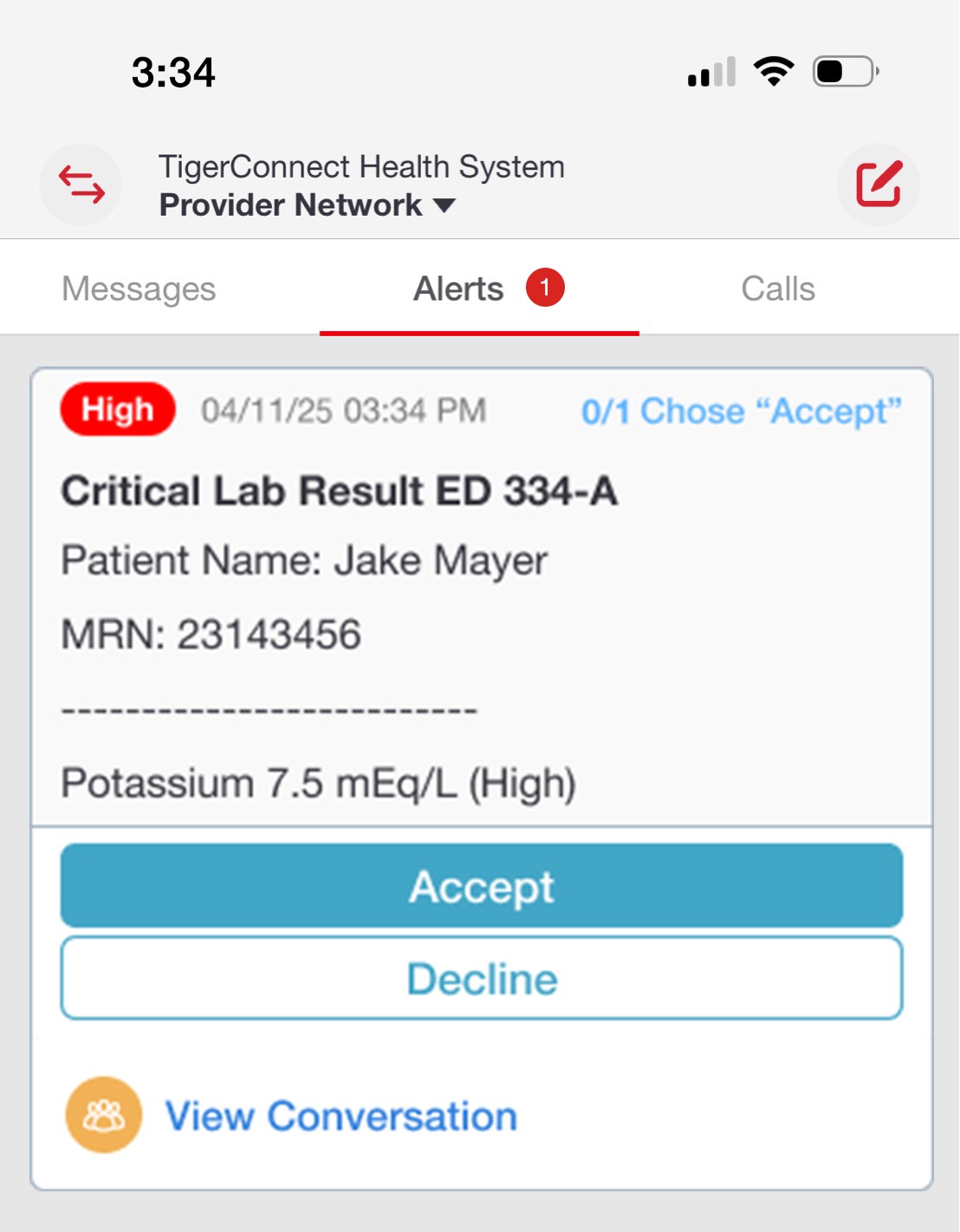
- Actionable notifications deliver significant or time-sensitive results directly to the ordering provider (and covering provider by role) with acknowledgment.
- Compliance windows (e.g., “read within 2 or 4 hours”) are supported with automatic escalation.
- Customers have improved turnaround time on follow-up orders by moving from passive inbox messages to push notifications routed by role.
Telemetry, Nurse Call & Device Integrations
- Rhythm changes, bed exit, infusion pump alerts, and safety alarms route immediately to the assigned nurse or covering role.
- Policy-based escalation—if unacknowledged, the alert rolls to the charge nurse or backup role.
- Fewer overhead pages and minimal hallway phone tag, more direct, accountable action.
Safer Transfers & Handoffs (Within and Between Facilities)
CareConduit and Transfer workflows help teams move patients with fewer gaps and greater accountability:
- Standardized transfer packets: Problem list, meds, isolation status, device lines/tubes, pending labs—automatically packaged.
- Assigned responsibilities: Who’s sending? Who’s receiving? Who’s transporting? All clear by role.
- Timestamped, auditable thread: Every acknowledgment and exception is visible, enabling closed-loop handoffs and easier post-event review.
Tackling Alarm & Alert Fatigue by Reducing Cognitive Load
Alert overload increases stress and error probability. We can directly address the cognitive dissonance clinicians feel when systems compete for attention:
- Curate the signal: Route only relevant, actionable alerts to the person on duty.
- Bundle and deduplicate: Related alerts appear as a single, evolving thread.
- Make it easy: One tap acknowledge, quick-reply templates, and clear escalation rules reduce mental friction and improve consistency.
The Bottom Line
Time is tissue. When hospitals pair clear roles, AI-backed automated workflows, and actionable communication with a culture of high reliability, patients are safer, clinicians experience less cognitive burden, and organizations can demonstrate ROI through faster response times, fewer adverse events, and more consistent outcomes.
Let’s build (or optimize) the workflows that move your hospital from intent to impact—with measurable results.
Featured Resources



Related Articles



Learn more about TigerConnect’s AI-driven Care Orchestration Platform
Schedule a demo to see TigerConnect in action.