
In healthcare, clinical alarms are critical—but when they’re constant, inaccurate, or non-actionable, they create alarm fatigue, disrupting workflows and risking patient safety.
The Problem: Too Many Alarms, Too Little Action
- False alarms: Up to 99% in ICUs are triggered by patient movement.1
- Non-actionable alerts: Only 5-13% require intervention.2
- Nurse overload: Staffing shortages amplify fatigue and missed alarms.
Alarm fatigue leads to missed alerts, delayed care, and emotional strain on providers.3 Patients suffer disrupted sleep, increased stress, and even preventable adverse events.

Reduce Nurse Interruptions: Intelligently Managing Alerts & Alarms
Learn how intelligently managing alerts improves nurse retention, workflows, and patient safety
How can alarm fatigue be reduced?
Alarm fatigue is a significant issue for healthcare workers, leading to worse outcomes and often preventable patient harm. One effective solution is implementing a modern clinical communication and alarm management platform. Additional strategies include:
- Educating staff about the dangers of alarm fatigue
- Using secure messaging systems to route alarms accurately and on time
- Adopting integrated solutions that combine alarm management software with middleware
- Utilizing distinct alarm sounds for different priorities or severities4
- Routing alarms by severity to the appropriate level and type of staff
The Solution: Smarter Alarm Management
The response to clinical alarms is complex, so your alarm management system must allow flexibility and adaptability. Features like redirecting alarms to another caregiver, reducing alarm frequency, and integrating with multiple medical devices, cell phones, and other mobile platforms are essential to improving patient safety and reducing alarm fatigue.
Modern platforms—such as TigerConnect—reduce noise, prioritize alerts, and streamline response. When evaluating a reliable alarm management system, look for:
- Fast system-wide updates
- Mobile alerts with patient context
- Auto-escalation to available staff
- Integration with bedside monitors and EHRs
- Secure messaging for fast, HIPAA-compliant communication
These tools empower nurses to respond faster, minimize interruptions, and focus on meaningful care.
Implementation Essentials
A robust and reliable alarm management system should also provide:
- Context-rich notifications (i.e., patient name, location, alert priority, precautions)
- Customizable alarm limits
- Integration with multi-vendor devices and software
- Ability to leverage your own IT team to save time
- Actionable insights for managers and supervisors
- Flexibility to redirect or suppress alarms based on severity
By combining these capabilities, hospitals can significantly reduce alarm fatigue, improve staff satisfaction, and enhance patient safety.
Conclusion: Better Tools, Better Care
Alarm fatigue isn’t just a workflow issue—it’s a patient safety risk. With the right technology, hospitals can reduce interruptions, improve outcomes, and support their care teams.
Want to learn more about TigerConnect’s FDA-cleared alarm management solution? Watch our webinar: Introducing the First FDA-Cleared, Cloud-Native Alarm Management Solution or schedule a demo today!
- Sendelbach S, Funk M. Alarm fatigue: a patient safety concern. AACN Adv Crit Care. 2013;24(4):378-388. doi:10.1097/NCI.0b013e3182a903f9
- Lewandowska K, Mędrzycka-Dąbrowska W, Tomaszek L, Wujtewicz M. Determining Factors of Alarm Fatigue among Nurses in Intensive Care Units-A Polish Pilot Study. J Clin Med. 2023;12(9):3120. Published 2023 Apr 25. doi:10.3390/jcm12093120
- Albanowski K, Burdick KJ, Bonafide CP, Kleinpell R, Schlesinger JJ. Ten years later, alarm fatigue is still a safety concern. AACN Adv Crit Care. 2023;34(3):189-197. doi:10.4037/aacnacc2023662
- Hravnak M, Pellathy T, Chen L, et al. A call to alarms: Current state and future directions in the battle against alarm fatigue. J Electrocardiol. 2018;51(6S):S44-S48. doi:10.1016/j.jelectrocard.2018.07.024
Learn more about Clinical Collaboration Software Platform, Resident Scheduling Software, Physician Scheduling Software, Alarm Management & Event Notification Software & Patient Engagement Software.
Featured Resources

Related Articles



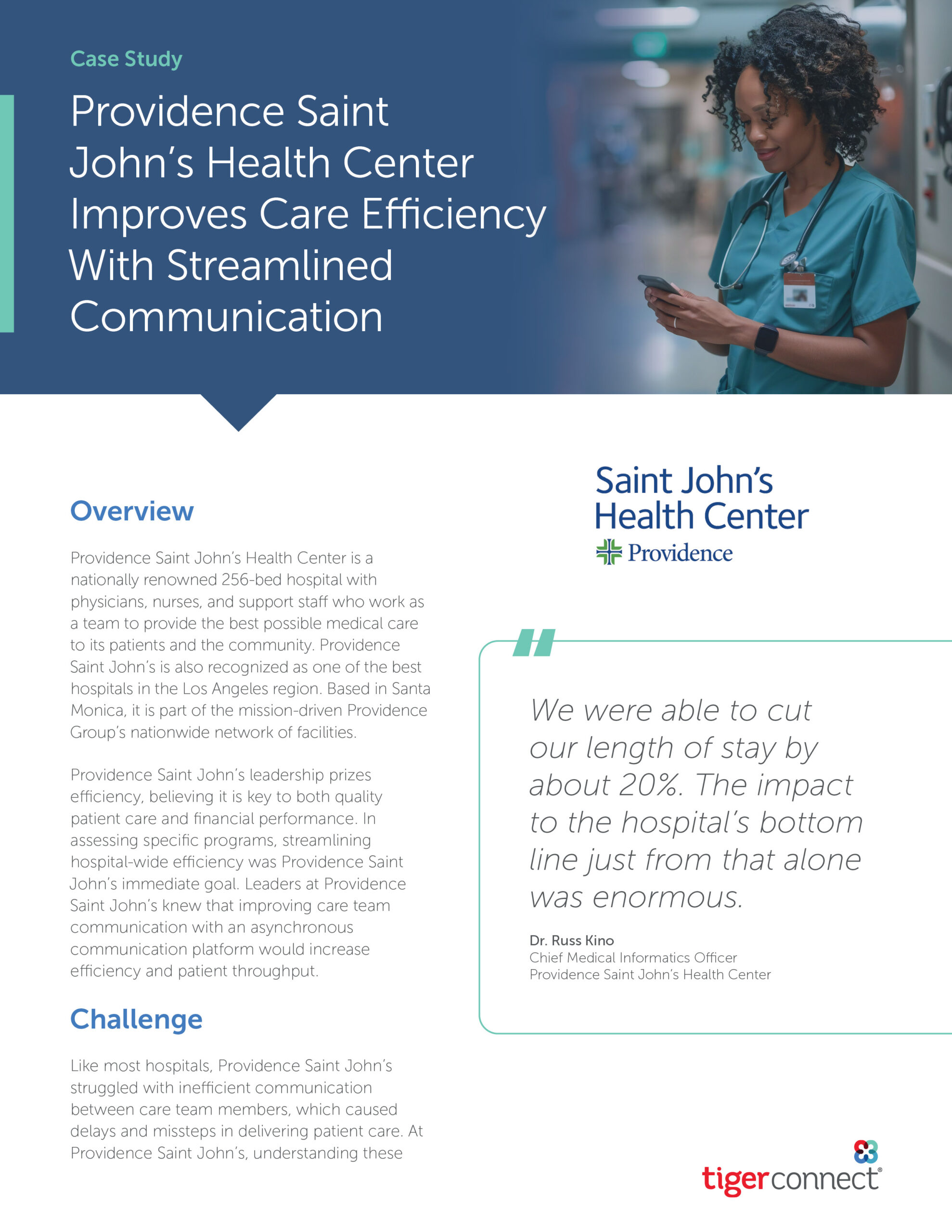
Providence Saint John’s Health Center Improves Care Efficiency with Streamlined Communication
Learn how Providence Saint John’s streamlined communication and reduced average length of stay (ALOS) by 20% with TigerConnect.


