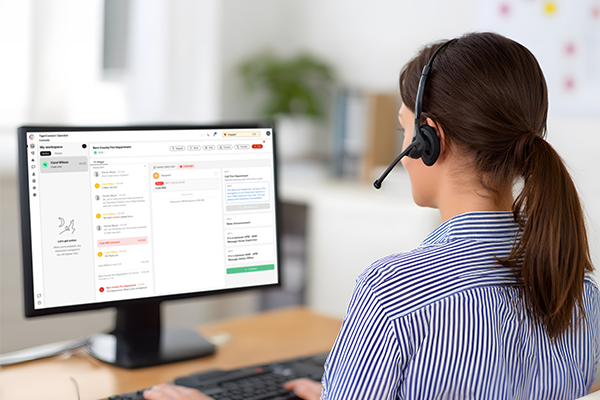

Over the last decade, hospital systems have become more connected, responsive, and financially sustainable operations. While significant technological advancements have been made to support these goals, the switchboard remains one of the last frontiers for digital innovation. For years, the hospital switchboard has been treated as a utility—high‑volume, always‑on, and chronically strained, but rarely viewed as a strategic asset. Yet it is one of the few places where every part of the enterprise converges: patients, families, clinicians, on‑call teams, service lines, and community partners.
Hospitals receive thousands of calls a day, and the operator teams that handle them still largely depend on legacy tech stacks that create operational inefficiencies that ripple across the enterprise. For health systems across the country, it’s clear that AI can transform this overlooked function into something far more powerful: an intelligent, anticipatory layer of the hospital’s operating model. For COOs, CIOs, and Digital Transformation leaders, the switchboard is no longer just a phone hub. It’s the first place where the hospital can demonstrate what a truly modern, connected health system feels like.
Three forces make the addition of AI to the switchboard both urgent and uniquely high-ROI.
1. AI creates a continuously available, infinitely scalable front door.
Health systems are moving toward a world where access must be instantaneous, personalized, and always on. But the traditional switchboard puts operator teams under extraordinary strain: rising call volumes, disconnected systems, and the complexity of routing across sprawling service lines. Even well-run teams struggle to maintain consistent service levels.
AI can absorb the high-volume, low complexity calls that dominate switchboard traffic, freeing operators to focus on detailed, sensitive, or high judgment interactions, such as distressed callers, escalations, or advanced routing. AI absorbs routine tasks, meaning:
- Every call is answered immediately, even during surges or staffing gaps.
- Call transcription is automated, keeping operators focused on making the right judgment calls during routine and urgent moments.
- Service levels become predictable, which reduces downstream friction for clinical and administrative teams.
- Contact centers scale elastically, giving the hospital a front door that never closes and never degrades.
The result is a more resilient access channel that doesn’t depend on perfect staffing conditions to perform. Adding AI to the switchboard gives the hospital a digital layer that ensures no patient, family member, or clinician ever waits for the system to catch up. In a future where access is a competitive differentiator, AI becomes the infrastructure that guarantees responsiveness at enterprise-wide scale.
2. AI elevates call routing into intelligent orchestration.
Traditional switchboard routing is a manual, repetitive, high-cognitive load task. Misroutes and repeat transfers are among the most common sources of operational friction and patient frustration. Operators must interpret caller intent, search for the right endpoint, and make judgment calls under pressure. Consistency, especially during surges, is not easy to achieve.
AI converts routing from a reactive task into a proactive, intelligence-driven workflow.
- Caller intent is interpreted with high accuracy, even when callers are stressed or multilingual.
- Routing decisions are consistent, compliant, and aligned with hospital policies, even when staffing is thin or operators are new.
- Operators are prompted with the recommended next-best action, preventing errors and shortening call handling times.
For COOs and CIOs, this is a shift from “call handling” to intelligent orchestration. AI establishes a system that not only routes but also understands, predicts, and guides so calls route directly to the correct endpoint, the first time. This allows hospitals to evolve a routine service interaction into a strategic advantage by improving caller experience for patients, families, and staff while bringing clarity and consistency to moments that matter most.
3. AI bridges disparate systems into one seamless search layer.
Most switchboard calls require operators to search across multiple systems: patient directories, on-call schedules, the EHR, and other internal knowledge bases. Operators access these systems one at a time, making it difficult to navigate under time pressure. Further, legacy switchboard technology cannot bring information together in a way that serves operator workflows.
AI changes this dynamic by becoming the connective tissue across systems. AI can:
- Search integrated directories, schedules, and knowledge repositories instantly, surfacing the right information without manual lookup.
- Eliminate the “swivel chair” problem—jumping between screens, tabs, and databases to answer a single question.
- Ensure information is consistent and current across operators and across time, reducing variability and error.
- Enable advanced capabilities such as answering complex queries (“Which cardiologist is covering consults at the main campus after 5 p.m.?”) or surfacing protocol-specific instructions instantly.
This is where AI becomes more than a routing engine. It becomes an enterprise search layer that makes the hospital’s operational knowledge accessible in real time. With AI seamlessly searching across all systems, operator teams work more efficiently, resolving calls faster and elevating performance across operational metrics.
Bringing it all together
AI on the switchboard isn’t a moonshot transformation. It’s a pragmatic, low-risk modernization of a critical access channel that touches nearly every operational domain: patient experience, clinical throughput, workforce efficiency, and digital transformation. For hospital leaders balancing financial pressure with rising expectations, it’s one of the fastest paths to measurable impact.
A visionary framing positions AI on the hospital switchboard not as an efficiency upgrade, but as a foundational shift in how health systems orchestrate human connection, operational intelligence, and the future of patient access.
Featured Resources


Related Articles